By Gerberal | July 16, 2026 | 10 min read
Table of Contents
- Why Bonds? Why Now? The Rate-Cutting Context
- Bond ETF Fundamentals: Duration, Yield, and Price Risk
- Aggregate Bond ETFs: AGG vs BND — The Core Bond Holding
- Treasury ETFs by Duration: SHY, IEF, TLT, EDV
- Corporate Bond ETFs: LQD, VCIT, SPLB — Taking Credit Risk
- TIPS: SCHP vs STIP — Inflation-Protected Bonds
- How Much in Bonds? A Framework for Equity Investors
1. Why Bonds? Why Now? The Rate-Cutting Context
For the past decade, bonds have been an afterthought for many equity investors. When the 10-year Treasury yielded 1.5% and the S&P 500 was compounding at 15% annually, asking "why bonds?" was a fair question.
But after the most aggressive Fed hiking cycle in 40 years, the landscape has shifted. As of mid-2026:
- The 10-year Treasury yields roughly 4.2% — not earth-shattering, but meaningfully positive real returns
- The Fed has begun cutting rates — from the 5.25-5.50% peak toward a projected 3.5-4.0% range
- Bond prices move inversely to yields — when rates fall, existing bonds become more valuable
This matters for three reasons:
-
Income is back. A 4%+ yield on government-guaranteed paper competes with the S&P 500's ~1.3% dividend yield and the Shiller CAPE ratio hovering near 35 — a level from which forward equity returns have historically been modest.
-
Duration works in your favor in a rate-cutting cycle. When the Fed cuts, longer-duration bonds appreciate. A 1% decline in the 10-year yield translates to roughly an 8% price gain for a fund like IEF (7-10 year Treasuries) and roughly 16% for TLT (20+ year Treasuries).
-
The correlation benefit. In the 2020 COVID crash, TLT rallied 20%+ while the S&P 500 fell 34%. In 2022, this correlation flipped — bonds and stocks fell together. In 2026, with inflation moderating and the Fed easing, bonds are reclaiming their traditional role as portfolio stabilizers.
The important caveat: A rate-cutting cycle is not guaranteed to continue uninterrupted. If inflation re-accelerates (as it did in 2023-2024 after initial optimism), the Fed could pause or reverse course, punishing bond holders. The 2022 drawdown in TLT — down over 30% — was historic. Bond investing is not risk-free.
2. Bond ETF Fundamentals: Duration, Yield, and Price Risk
Before picking an ETF, understand duration. Duration measures a bond's sensitivity to interest rate changes. A fund with a duration of 7 will gain roughly 7% in price for every 1% decline in yields — and lose roughly 7% for every 1% increase.
| Duration | What It Means | When to Favor |
|---|---|---|
| 0-2 years (ultra-short) | Near-cash, minimal rate sensitivity | Parking cash, rate uncertainty |
| 2-5 years (short) | Modest sensitivity, decent yield pickup | Rising rate environment |
| 5-10 years (intermediate) | Meaningful rate exposure | Neutral allocation |
| 10-20 years (long) | High sensitivity | Falling rate conviction |
| 20+ years (ultra-long) | Extreme sensitivity | Deflation hedge, rate-cut bets |
Key things bond ETFs do differently from individual bonds:
- Bond ETFs never mature. Unlike an individual bond that returns your principal on a specific date, a bond ETF maintains a constant duration by continuously buying new bonds and selling old ones. This means you never "lock in" a yield to maturity — the ETF's yield changes as the portfolio rolls over.
- Bond ETFs pay monthly dividends. Most distribute interest income monthly, which can be convenient for income-oriented investors.
- Bond ETF pricing is transparent and liquid. You can buy or sell at any time during market hours at a known price.
3. Aggregate Bond ETFs: AGG vs BND — The Core Bond Holding
For most equity investors, the bond question starts and ends with a single fund: an aggregate bond ETF that holds a diversified mix of US government bonds, mortgage-backed securities, and investment-grade corporate bonds.
| ETF | Ticker | Expense Ratio | Holdings | SEC Yield | Duration |
|---|---|---|---|---|---|
| iShares Core US Aggregate Bond ETF | AGG | 0.03% | ~10,000+ | ~4.5% | ~6 years |
| Vanguard Total Bond Market ETF | BND | 0.03% | ~11,000+ | ~4.5% | ~6 years |
AGG and BND are nearly identical. Both track the Bloomberg US Aggregate Bond Index ("the Agg"). Both charge 3 basis points. Both hold roughly the same mix: ~70% US government and agency bonds, ~25% investment-grade corporates, ~5% other. Their performance diverges by maybe 10-20 basis points per year — noise, not signal.
The case for AGG/BND as your only bond holding: It's diversified, liquid, and cheap. You get exposure to the entire US investment-grade bond market in one fund. For 90% of equity investors who want "some bonds" in their portfolio, AGG or BND is the right answer. Pick whichever your brokerage offers commission-free.
The case against: The Agg is heavily weighted toward US government debt (~70%). If you want more credit exposure (corporate bonds), or more duration precision (specific Treasury maturities), you'll need to build your own mix. But the simplicity argument for a single aggregate fund is strong.
Historical perspective: AGG/BND have delivered roughly 1.5-2% annualized over the past 5 years — dragged down by the 2022 bond crash. Over the prior decade (2009-2019), they returned roughly 3-4% annualized. With starting yields now above 4%, forward-looking returns are materially higher than what recent history shows.
4. Treasury ETFs by Duration: SHY, IEF, TLT, EDV
If you prefer to control your duration exposure directly — rather than accepting the Agg's ~6-year duration — Treasury-only ETFs let you dial in your rate sensitivity with precision.
| ETF | Ticker | Duration | Expense Ratio | SEC Yield | Max Drawdown (2022) |
|---|---|---|---|---|---|
| iShares 1-3 Year Treasury ETF | SHY | ~1.9 years | 0.15% | ~4.2% | -5% |
| iShares 7-10 Year Treasury ETF | IEF | ~7.5 years | 0.15% | ~4.3% | -15% |
| iShares 20+ Year Treasury ETF | TLT | ~16.5 years | 0.15% | ~4.5% | -31% |
| Vanguard Extended Duration Treasury ETF | EDV | ~24 years | 0.06% | ~4.6% | -40%+ |
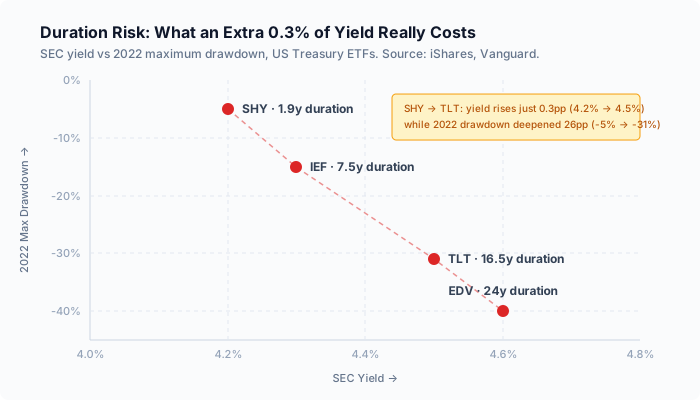
SHY (1-3 year): This is essentially a cash alternative with a modest yield pickup. In a rate-cutting cycle, it benefits the least — its short duration means small price gains from falling rates. Use it for cash you might need within 12-24 months.
IEF (7-10 year): The sweet spot for many investors. Enough duration to benefit meaningfully from rate cuts, but not so much that you get destroyed if rates rise. It's comparable to the Agg in duration but without corporate credit risk.
TLT (20+ year): This is a macro bet, not a bond allocation. TLT amplifies every rate move — it gained 18% in 2019 (rates fell), lost 31% in 2022 (rates surged), gained 25% in 2020 Q1 (flight to safety). If you have conviction that the Fed will cut rates aggressively, TLT is the levered play. If you're wrong, losses are equity-like in magnitude.
EDV (extended duration, zero-coupon): Duration of ~24 years with only 6 basis points in fees. This is effectively a bet on long-term disinflation or deflation. EDV moves 2.4x what IEF moves for the same rate change. For context: a 1% decline in 30-year yields would add roughly 24% to EDV's price. A 1% increase would subtract the same. This is not a "bond allocation" — it's a tactical instrument.
A practical note on TLT vs EDV: If you want to bet on falling long-term rates, TLT is aggressive enough for almost everyone. EDV's 24-year duration means a 50-basis-point rate move translates to a 12% price swing. The incremental reward over TLT rarely justifies the incremental risk for individual investors.
5. Corporate Bond ETFs: LQD, VCIT, SPLB — Taking Credit Risk
Treasury bonds protect you from interest rate risk. Corporate bonds add credit risk — the risk that the issuing company defaults. In exchange, you earn a higher yield. The spread between investment-grade corporate bonds and Treasuries is called the credit spread.
| ETF | Ticker | Expense Ratio | Credit Quality | Duration | SEC Yield |
|---|---|---|---|---|---|
| iShares iBoxx $ Investment Grade Corporate Bond ETF | LQD | 0.14% | A to BBB | ~8.3 years | ~5.0% |
| Vanguard Intermediate-Term Corporate Bond ETF | VCIT | 0.04% | A to BBB | ~6.3 years | ~4.8% |
| SPDR Portfolio Long Term Corporate Bond ETF | SPLB | 0.04% | A to BBB | ~13 years | ~5.5% |
LQD (0.14%) is the benchmark for investment-grade corporate bonds. It holds roughly 2,500 bonds from companies like JPMorgan, Apple, and Bank of America — all rated BBB or above. At ~5.0% yield, you get about 70 basis points of spread over Treasuries. The tradeoff: corporate bonds are more correlated with equities than Treasuries are. In a recession, credit spreads widen and LQD falls — exactly when you want your bonds to hold up.
VCIT (0.04%) is the cheaper alternative with slightly lower duration (6.3 vs 8.3 years) and slightly lower yield. At 4 basis points, it's one of the best values in fixed-income ETFs.
The corporate bond reality check: During the 2020 COVID crash, LQD fell 20% in two weeks before the Fed stepped in with its corporate bond buying program. Without Fed backstopping, investment-grade corporates behave more like "equity-light" than "Treasury-plus" in a crisis. If you hold corporates, understand that their diversification benefit is weaker, their correlation with stocks is higher, and their protection in a selloff is less reliable.
For most equity investors: If you're adding bonds specifically for diversification during equity drawdowns, stick with Treasuries. If you're adding bonds primarily for income—and can tolerate some equity-like drawdown behavior—corporate bonds offer a meaningful yield pickup.
6. TIPS: SCHP vs STIP — Inflation-Protected Bonds
Treasury Inflation-Protected Securities (TIPS) adjust their principal value based on the Consumer Price Index (CPI). If inflation runs at 3%, a TIPS bond's principal increases 3% — and you earn interest on the inflation-adjusted amount.
| ETF | Ticker | Expense Ratio | Duration | Real Yield |
|---|---|---|---|---|
| Schwab US TIPS ETF | SCHP | 0.03% | ~6.7 years | ~1.8% |
| iShares 0-5 Year TIPS ETF | STIP | 0.03% | ~2.4 years | ~2.0% |
| Vanguard Short-Term Inflation-Protected Securities ETF | VTIP | 0.04% | ~2.4 years | ~2.0% |
A key concept: real yield vs nominal yield. When SCHP shows a 1.8% real yield, that means you earn 1.8% plus whatever inflation turns out to be. If inflation averages 2.5% over the next 5 years, your total return is roughly 4.3% — comparable to nominal Treasuries but with inflation protection built in.
When TIPS outperform: In a rising-inflation environment where the Fed is hiking rates. In 2022, SCHP fell only 12% vs TLT's 31% — the inflation adjustment cushioned the duration-driven price decline.
When TIPS underperform: In a falling-inflation, falling-rate environment. If inflation drops to 1.5% while nominal bonds yield 4%, you're giving up 2.5 percentage points annually for insurance you don't need.
For 2026: With inflation moderating toward the Fed's 2% target but sticky above it, TIPS offer a reasonable inflation hedge at modest cost. SCHP is the default choice for core TIPS exposure; STIP/VTIP work if you want inflation protection without duration risk.
7. How Much in Bonds? A Framework for Equity Investors
The classic 60/40 portfolio (60% stocks, 40% bonds) was built for an era of 6% bond yields and negative stock/bond correlation. In 2022, that correlation broke — bonds and stocks cratered together. In 2026, with yields higher and the Fed cutting, the correlation dynamic is shifting again.
A practical allocation framework based on what bonds are for in your portfolio:
| Role of Bonds | % Allocation | Which Bond ETF | Rationale |
|---|---|---|---|
| Pure stabilizer / dry powder | 5-10% | SHY or BIL | Cash-like, no duration risk, ready to deploy into equities during drawdowns |
| Moderate diversification | 10-20% | AGG or BND | Broad, cheap, one-fund simplicity |
| Duration bet on rate cuts | 5-10% (tactical) | TLT or IEF | Only if you have a macro view; size it like a satellite position |
| Income generation (retirement) | 20-40% | Mix of BND + VCIT + SCHP | Higher yield, split across government and credit |
Three rules of thumb for equity-heavy investors:
-
Know why you own bonds. If you own them to buy dips in stocks during crashes, stick with short-duration Treasuries. If you own them for income, duration and credit exposure are fine. If you can't articulate why you own bonds beyond "I was told to," start with AGG and figure it out over time.
-
Bond losses hurt more psychologically than equity losses. A 30% drawdown in TLT feels worse than a 30% drawdown in SPY — because bonds are supposed to be the "safe" part of your portfolio. Size your bond duration accordingly. If you can't sleep through a 15% bond drawdown, keep your duration under 7 years.
-
At current yields (4%+), bonds earn their keep. The worst-case scenario for bond investors — zero or negative real yields — is not the world we're in. Positive real yields mean bonds are generating genuine income even if rates don't move in your favor. That's a much better starting point than 2020.
The simplest path: If you're reading this as an equity investor who just wants a reasonable bond allocation without overthinking it — buy BND (or AGG), allocate 10-20% of your portfolio, reinvest dividends, and stop checking it. Bonds at 4%+ yields are earning their keep. Don't try to time the rate cycle.
Sources
- iShares by BlackRock — AGG (iShares Core US Aggregate Bond ETF), TLT (iShares 20+ Year Treasury Bond ETF), and LQD (iShares iBoxx Investment Grade Corporate Bond ETF) fund pages
- Vanguard — BND (Vanguard Total Bond Market ETF) fund page and fact sheet
- Bloomberg — Bloomberg US Aggregate Bond Index methodology and historical data
- Federal Reserve (FRED) — federal funds rate, Treasury yield curve, and monetary policy data
- US Department of the Treasury — Treasury yield data and auction results (Treasury.gov)
- Morningstar — fixed income ETF category analysis, duration, and credit quality reports
- ICE (Intercontinental Exchange) — ICE BofA US Corporate Index (LQD benchmark) methodology
- SIFMA (Securities Industry and Financial Markets Association) — US bond market annual statistics
Disclaimer: This article is for informational purposes only and does not constitute investment advice. Bond ETFs carry interest rate risk, credit risk, and inflation risk. Past bond market behavior — including historical correlations with equities — may not persist. Yields and durations referenced are approximate and change with market conditions. Consult a professional advisor before making investment decisions.
More ETF portfolio-building articles: