By Gerberal | June 30, 2026 | 9 min read
If the S&P 500 represents American capitalism and the CSI 300 captures China's domestic economy, the Hang Seng Index (HSI) sits at the intersection — a Hong Kong benchmark that is equal parts global financial hub and Chinese economic proxy. Its 82 constituents span HSBC, AIA, Tencent, Alibaba, and China's Big Four banks.
In 2026, the HSI presents a study in contrasts: it's the cheapest of the four major indices we track (12.5x PE vs. 28x for Nasdaq-100), offers the highest dividend yield (~3%), and has one of the world's lowest-cost broad-market ETFs (0.07%). Yet it has been dead flat year-to-date, weighed down by financial sector concentration and geopolitical uncertainty.
This guide covers everything a global investor needs to know about HSI ETFs — the dominant Tracker Fund, the alternatives, and how the HSI fits into a cross-border portfolio alongside CSI 300 and S&P 500 exposure.
The Hang Seng Index at a Glance
| Metric | Hang Seng Index | S&P 500 | CSI 300 | Nasdaq-100 |
|---|---|---|---|---|
| PE Ratio | 12.5x ✅ | 21.6x | 17.6x | 28.0x |
| Dividend Yield | ~3.0% ✅ | 1.3% | 2.7% | 0.4% |
| YTD 2026 Return | ~0% | +11% | +8% | +16.5% |
| 1-Year Return | ~+2% | +26% | +31% | +34% |
| 5-Year Annualized | ~+0% | +13.5% | +7% | +19% |
| Constituents | 82 | 503 | 300 | 100 |
| Top Sector | Financials (34%) | Tech (39%) | Tech (33%) | Tech (58%) |
| Benchmark ETF ER | 0.07% (2800.HK) | 0.03% (VOO) | 0.20% (510300) | 0.15% (QQQM) |
Data as of late June 2026. Sources: Morningstar, Yahoo Finance, StockAnalysis, iShares, CSOP.
The most striking number is the 5-year annualized return: roughly 0%. The HSI peaked in early 2021 and has been in a grinding, multi-year consolidation. Hong Kong's economy — squeezed between China's property correction and U.S.-China decoupling — has not participated in the global equity rally. This creates both a cautionary tale and, arguably, a valuation opportunity.
Sector Composition: A Financials-Heavy Index
The HSI's sector weights are fundamentally different from its peers:
| Sector | HSI Weight | S&P 500 Weight | Why Different |
|---|---|---|---|
| Financials | 33.9% | 11.1% | HSBC, AIA, Big 4 Chinese banks dominate |
| Consumer Cyclical | 19.7% | 10.0% | Alibaba, Meituan, JD.com, Xiaomi |
| Communication | 14.6% | 9.0% | Tencent, China Mobile, NetEase |
| Technology | 6.1% | 39.2% | Huge gap — HK has no Nvidia/Apple equivalent |
| Energy | 6.0% | 3.8% | CNOOC, PetroChina, Sinopec |
| Property | 4.3% | 2.3% | Legacy HK property developers |
| Industrials | 4.3% | 8.5% | Relatively underrepresented |
| Healthcare | 3.8% | 11.3% | Small but growing biotech presence |
| Utilities | 2.6% | 2.4% | CLP, HK Electric |
| Other | 4.7% | 2.4% | — |
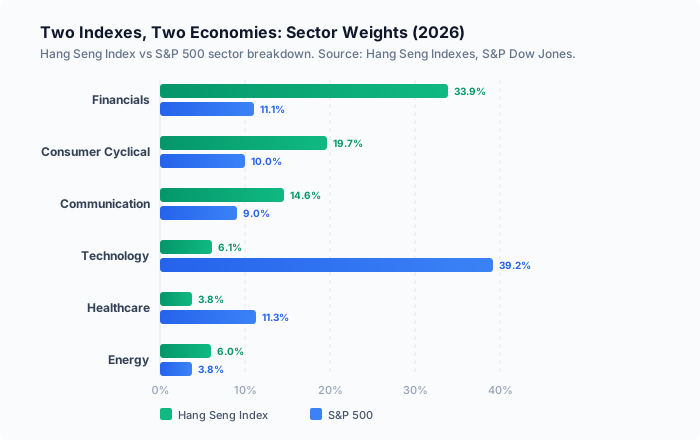
Three realities stand out:
1. Financials are a third of the index. HSBC alone is 8.3% of the HSI. If you already own S&P 500 and CSI 300, adding HSI exposure significantly tilts your portfolio toward banks and insurers — for better (dividends) or worse (cyclicality).
2. Technology is underweighted — but misleadingly so. Tencent (7.3%), Alibaba (7.5%), Xiaomi (3.3%), and Meituan (2.8%) are classified as "Consumer Cyclical" or "Communication Services" in HSI methodology, not "Technology." The actual tech-like exposure in the HSI is closer to 30% when you reclassify these names.
3. Property is small but significant. At 4.3%, property is small — but the sector's indirect influence through bank loan books and consumer confidence is far larger than the weight suggests.
Top 10 Holdings: Banks, Tech, and Insurers
| Rank | Company | Ticker | Weight | Sector |
|---|---|---|---|---|
| 1 | HSBC | 0005.HK | 8.3% | Financials |
| 2 | Alibaba | 9988.HK | 7.5% | Consumer Cyclical |
| 3 | Tencent | 0700.HK | 7.3% | Communication |
| 4 | AIA Group | 1299.HK | 5.5% | Financials |
| 5 | China Construction Bank | 0939.HK | 5.2% | Financials |
| 6 | ICBC | 1398.HK | 3.6% | Financials |
| 7 | Xiaomi | 1810.HK | 3.3% | Consumer Cyclical |
| 8 | China Mobile | 0941.HK | 3.2% | Communication |
| 9 | HKEX | 0388.HK | 3.1% | Financials |
| 10 | Meituan | 3690.HK | 2.8% | Consumer Cyclical |
The top 10 account for roughly 50% of the index. Notice that five of the top ten are financials — and three are Chinese state-owned banks. This concentration is the HSI's biggest structural risk: if China's banking sector faces stress from the property downturn, the index feels it disproportionately.
The ETF Landscape: One Dominant Fund
Tracker Fund of Hong Kong (2800.HK) — The 800-Pound Gorilla
| Metric | Value |
|---|---|
| Ticker | 2800.HK (RMB counter: 82800.HK) |
| Full Name | Tracker Fund of Hong Kong |
| Manager | State Street Global Advisors / Hang Seng Investment |
| Expense Ratio | 0.07% (~0.04% management + 0.03% other) |
| AUM | ~HK$135 billion (~US$17 billion) |
| Inception | November 1999 |
| Dividend Yield | ~3.2% (semi-annual distribution) |
| Avg Daily Turnover | ~HK$5.8 billion |
| PE Ratio | ~13.2x |
| Top 10 Weight | ~50% |
Tracker Fund holds over 90% market share among HSI ETFs. It's consistently one of the top-5 most traded securities on the Hong Kong Exchange. Its 0.07% expense ratio makes it one of the cheapest broad-market ETFs in Asia — cheaper than 510300 (0.20%) and cheaper than ASHR (0.65%).
Why so cheap? Tracker Fund was created by the Hong Kong government in 1999 as a disposal vehicle for shares it bought during the 1998 Asian financial crisis intervention. The massive initial seeding (~HK$33 billion) gave it permanent economies of scale that competitors have never matched. This is the rare case where government intervention produced a genuinely pro-investor outcome.
Alternatives
| ETF | Ticker | Expense Ratio | AUM | Notes |
|---|---|---|---|---|
| iShares Core HSI ETF | 3115.HK | 0.12% | Smaller | BlackRock; modest liquidity |
| CSOP HSI ETF | 3037.HK | 0.18% | Smaller | CSOP; limited volume |
| Hang Seng H-Share ETF | 2828.HK | 0.60% | ~HK$25B | Tracks HSCEI (China Enterprises), not HSI |
Verdict: 2800.HK is the clear winner — lowest cost, highest liquidity, institutional-grade infrastructure. The alternatives exist but offer no compelling reason to choose them over the dominant fund.
How Global Investors Access 2800.HK
| Channel | Access | Notes |
|---|---|---|
| Interactive Brokers | Direct — trade 2800.HK on HKEX | Lowest cost; HK$ commission |
| Stock Connect (Southbound) | Mainland China → HK | Chinese investors buying HK stocks |
| US brokerages | Via IB or Schwab Global | Most US brokers don't offer direct HK trading; IB does |
| No US-listed pure HSI ETF | N/A | EWH (iShares MSCI Hong Kong) is the closest US-listed alternative but tracks a different, narrower index (0.50% ER) |
If you can't access HKEX directly, EWH (iShares MSCI Hong Kong ETF, 0.50% ER) is the fallback — but it's a different index with different weights. EWH is more Hong Kong-local-property-heavy and has fewer mainland Chinese names.
Why the HSI Has Lagged (And Could That Change?)
The HSI's 5-year annualized return of roughly zero is not random. A confluence of structural headwinds explains the underperformance:
-
China property crisis. The multi-year real estate downturn has hit Chinese banks (heavy HSI weight) and consumer confidence in a way the S&P 500 never experienced post-2008.
-
Tech regulation. China's 2021 tech crackdown hit Tencent, Alibaba, and Meituan — which collectively are ~18% of the HSI — at the worst possible moment, just as U.S. tech stocks were beginning their AI-driven surge.
-
No AI exposure. The HSI has no Nvidia, no Microsoft, no Broadcom. Its "technology" exposure is in internet platforms and telecom — not the AI semiconductor supply chain that has driven U.S. outperformance.
-
Geopolitical discount. The U.S.-China tensions, potential Taiwan conflict scenarios, and Western capital outflows have compressed HK equity multiples structurally.
The Bull Case for a Turnaround
- Valuation: At 12.5x PE with a 3% yield, the HSI is priced for permanent stagnation. Any positive catalyst — China stimulus, property stabilization, improved U.S.-China relations — could trigger a significant multiple expansion.
- Dividend support: Chinese SOEs (state-owned enterprises) are under explicit government pressure to increase dividends. ICBC and CCB are yielding 6-7%. This provides a floor under the HSI that didn't exist five years ago.
- Share buybacks: Tencent and Alibaba have been buying back shares aggressively — a new behavior for Chinese tech companies that could support returns even if revenue growth remains modest.
How the HSI Fits in a Global Portfolio
| Portfolio Role | HSI Allocation | Rationale |
|---|---|---|
| Diversifier from US tech | 5–10% | Low correlation to Nasdaq-100; financials-heavy |
| Income sleeve | 10–15% | 3% yield + growing dividends from SOEs |
| Value tilt | 5–10% | Cheapest major index at 12.5x PE |
| Pure-play HK/China bet | 15–20% | Aggressive; high geopolitical risk |
Suggested combination: Instead of choosing between CSI 300 and HSI, consider a 60/40 split — 60% CSI 300 (broader China exposure, more tech) and 40% HSI (higher dividends, lower volatility, financials-heavy). The two indices are complementary.
Key Takeaways
-
2800.HK is the best HSI ETF — 0.07% expense ratio, dominant liquidity, 26-year track record. The alternatives offer no advantage.
-
The HSI is the cheapest major index at 12.5x PE — but that discount has persisted for years. Cheap doesn't mean it will re-rate soon.
-
Financials dominate at 34% — if you're concerned about China's banking sector, the HSI is risky. If you believe Chinese banks are undervalued, the HSI is the play.
-
No US-listed pure HSI ETF exists — use EWH as a loose proxy, or trade 2800.HK directly via Interactive Brokers for the real thing.
-
The HSI pairs well with CSI 300 — the former gives you financials, dividends, and HK-listed tech; the latter gives you onshore A-shares, semiconductors, and consumer names.
Next on ETF Bridge: We compare US and China dividend ETFs — SCHD vs VYM vs China high-dividend funds. Which market pays income investors better? Read the Dividend ETF Showdown →
Sources
- Morningstar — Tracker Fund of Hong Kong (2800.HK) fund page
- StockAnalysis — 2800.HK key metrics and price history
- Yahoo Finance — CSOP HSI ETF (3037.HK) and iShares Core HSI ETF (3115.HK)
- Hang Seng Indexes Company — HSI methodology and constituent data
- The Standard (Hong Kong) — "CSOP SK Hynix leveraged product overtakes Tracker Fund" (June 2026)
- ETF.com / iShares — EWH and China ETF comparisons
Continue reading: Round out your Asia portfolio knowledge — compare the HSI with our CSI 300 ETF Guide for onshore China exposure, explore China tech ETFs like KWEB for a different sector mix, or see how Japan ETFs stack up as another Asian developed-market option.
Disclaimer: ETF Bridge is an educational resource. This article does not constitute investment advice. Past performance does not guarantee future results. Investing in Hong Kong equities involves unique risks including geopolitical tensions, regulatory changes, and currency fluctuations. All data is current as of late June 2026 and may change. Always verify information with the official fund provider and consult a qualified financial advisor.