By Gerberal | June 29, 2026 | 12 min read
If the S&P 500 is America's corporate scoreboard, the CSI 300 is China's. It tracks the 300 largest and most liquid A-share stocks listed on the Shanghai and Shenzhen exchanges — from Kweichow Moutai, the iconic baijiu maker, to CATL, the world's largest EV battery producer, to Zhongji Innolight, an AI optical module giant that has surged to become the index's top holding.
But investing in the CSI 300 as a global investor isn't as simple as buying VOO. You face a choice between onshore Chinese ETFs (like the $190 billion monster 510300) and offshore U.S.-listed ETFs (like ASHR). You need to understand the "national team" — a state-backed investor that owns over 80% of some CSI 300 ETFs. And you need to appreciate a sector composition that looks very different from the S&P 500's tech-heavy profile.
This guide covers everything a global investor needs to know about CSI 300 ETFs in mid-2026.
What Is the CSI 300 Index?
The CSI 300 Index (沪深300指数) is the benchmark for China's A-share market. It selects the 300 largest stocks by market capitalization and trading liquidity from the Shanghai and Shenzhen exchanges, rebalanced semi-annually.
| Feature | CSI 300 | S&P 500 |
|---|---|---|
| Number of Stocks | 300 | ~503 |
| Market Represented | China A-shares (Shanghai + Shenzhen) | U.S. equities |
| Weighting | Float-adjusted market cap | Float-adjusted market cap |
| Biggest Sector | Technology (~32%) | Technology (~39%) |
| Second Sector | Financials (~19%) | Financials (~11%) |
| PE Ratio (TTM, June 2026) | ~17.6x | ~21.6x |
| Dividend Yield | ~2.7% (index level) | ~1.3% |
| YTD 2026 Return | ~+8% | ~+11% |
| 1-Year Trailing Return | ~+31% | ~+26% |
| Key Distinction | Heavy state-influenced ownership; higher dividend yield; lower valuation | Pure market-driven; lower yield; higher multiple |
Key insight: The CSI 300 is both cheaper (17.6x vs. 21.6x PE) and yields more (2.7% vs. 1.3%) than the S&P 500 as of mid-2026. The discount reflects structural differences — state ownership, regulatory risk, and currency considerations — not necessarily fundamental inferiority.
Sector Composition: China Is Not Just Tech
The CSI 300 in 2026 looks meaningfully different from a few years ago:
| Sector | CSI 300 Weight | S&P 500 Weight | Key Difference |
|---|---|---|---|
| Technology | 32.5% | 39.2% | S&P more tech-heavy |
| Financials | 19.0% | 11.1% | CSI 300 nearly 2x more financials |
| Industrials | 16.3% | 8.5% | China's manufacturing heft |
| Basic Materials | 10.0% | 2.2% | Major structural difference |
| Consumer (Defensive + Cyclical) | 11.7% | 16.0% | U.S. more consumer-driven |
| Healthcare | 3.7% | 11.3% | U.S. healthcare vastly larger |
| Energy | 2.5% | 3.8% | Similar |
| Utilities | 2.8% | 2.4% | Similar |
| Other | 1.5% | 5.5% | — |
Two things stand out:
-
Materials and Industrials are massive — China's status as the world's factory is reflected in a combined 26.3% weight for industrial cyclicals, compared to ~10.7% in the S&P 500.
-
Healthcare is tiny — at just 3.7%, it's a fraction of the S&P 500's 11.3%. China's healthcare sector is still maturing, and many of its largest pharma and biotech firms remain smaller-cap or listed in Hong Kong.
Top Holdings: The Rise of AI Hardware
The CSI 300's top 10 holdings tell the story of China's economy in 2026:
| Rank | Company | Sector | Weight | What It Does |
|---|---|---|---|---|
| 1 | Zhongji Innolight (300308) | Tech | 5.0% | #1 global supplier of 800G optical modules for AI data centers |
| 2 | CATL (300750) | Industrials | 3.8% | World's largest EV battery maker (~37% global market share) |
| 3 | Kweichow Moutai (600519) | Consumer Defensive | 2.8% | China's most valuable consumer brand — baijiu (liquor) |
| 4 | Eoptolink Technology (300502) | Tech | 2.8% | Optical transceivers — another AI infrastructure play |
| 5 | Ping An Insurance (601318) | Financials | 2.0% | China's largest insurer by market cap |
| 6 | Zijin Mining (601899) | Materials | 1.8% | Major gold and copper miner |
| 7 | China Merchants Bank (600036) | Financials | 1.7% | Most respected retail/commercial bank in China |
| 8 | Cambricon Technologies (688256) | Tech | 1.5% | China's leading AI chip designer |
| 9 | Midea Group (000333) | Consumer Cyclical | 1.4% | World's largest home appliance maker |
| 10 | GigaDevice Semiconductor (603986) | Tech | 1.3% | Memory chips and MCUs |
What's changed: Two optical module makers (Zhongji Innolight and Eoptolink) now sit in the top 5 — a direct result of the global AI buildout. China controls over 60% of the global optical module supply chain, and AI data center demand has driven these stocks up 200%+ over the past 18 months.
Compare this to the S&P 500, where Nvidia, Apple, and Microsoft each command ~5-8% — the CSI 300's top names are less concentrated but more exposed to hardware supply chains than software platforms.
How to Invest: The ETF Landscape
Global investors have two paths to CSI 300 exposure: onshore Chinese ETFs (cheaper, larger, but harder to access) and offshore U.S.-listed ETFs (more expensive, but accessible via any brokerage).
Path A: Onshore China ETFs (Lowest Cost, Largest Scale)
| ETF | Ticker | Exchange | AUM (approx.) | Expense Ratio | Note |
|---|---|---|---|---|---|
| Huatai-PineBridge CSI 300 | 510300 | Shanghai | 0.15% + 0.05% = 0.20% | Largest CSI 300 ETF. Sole underlying for CSI 300 ETF options. Stock Connect eligible. | |
| Harvest CSI 300 | 159919 | Shenzhen | ~¥45B | 0.50% | Second largest CSI 300 tracker. |
| China AMC CSI 300 | 510330 | Shanghai | ~¥32B | 0.50% | Third largest. |
How to access as a foreign investor:
- Stock Connect (Northbound): If your broker supports Shanghai/Shenzhen-Hong Kong Stock Connect, you can buy 510300 directly. Check with Interactive Brokers, HSBC, or your private bank.
- QFII/RQFII: Institutional route — not available to retail.
- Hong Kong-listed feeder ETFs: Funds like the Hang Seng Harvest CSI 300 ETF (83130.HK) provide Hong Kong-listed access, though with wider spreads and lower liquidity.
The big story in 2026: The 510300 ETF saw the "national team" — Central Huijin, China's sovereign wealth vehicle — reduce its holdings dramatically in January 2026, triggering record single-day outflows of ¥20 billion (~$2.9B). This was interpreted as a cooling signal rather than a fundamental bearish call. Institutional ownership still dominates this ETF, making it less purely market-driven than VOO or IVV.
Path B: U.S.-Listed ETFs (Easiest Access for Global Investors)
| ETF | Ticker | Expense Ratio | AUM | Index Tracked | Key Feature |
|---|---|---|---|---|---|
| Xtrackers Harvest CSI 300 China A-Shares | ASHR | 0.65% | ~$1.7B | CSI 300 Index | Direct physical A-share exposure — the go-to for U.S. investors |
| iShares MSCI China A | CNYA | 0.60% | ~$233M | MSCI China A Inclusion Index | Broader (~416 holdings), slightly cheaper than ASHR |
| KraneShares Bosera MSCI China A | KBA | 0.60% | ~$350M | MSCI China A Index | Similar to CNYA, smaller AUM |
| iShares China Large-Cap | FXI | 0.74% | ~$5.5B | FTSE China 50 | Not CSI 300. Hong Kong-listed large caps only (Tencent, Alibaba, Meituan). No A-shares. |
| iShares MSCI China | MCHI | 0.59% | ~$6.5B | MSCI China | Broad China — includes HK listings, ADRs, and some A-shares |
ASHR vs. Onshore: The Fee Tradeoff
| Metric | ASHR (U.S.-listed) | 510300 (Shanghai) |
|---|---|---|
| Expense Ratio | 0.65% | 0.20% |
| Annual cost per $10K | $65 | $20 |
| 10-year fee cost on $100K | ~$6,500 | ~$2,000 |
| AUM | $1.7B | ~$19B |
| Dividend Yield | ~1.9% (ETF-level) | ~4.3% (TTM, post-record dividend) |
| Accessibility | Any U.S. brokerage | Stock Connect or onshore account required |
| Tax Efficiency | Standard ETF — no PFIC issues | May trigger PFIC reporting for U.S. taxpayers |
| Tracking Method | Physical replication via Harvest Fund Management | Physical replication |
| Liquidity | Moderate (~$20M daily volume) | Very high (~¥6B daily turnover) |
The 0.45% premium: ASHR charges 45 basis points more than 510300. Over 20 years, that's real money. But for most global investors, the convenience of buying through a standard brokerage account outweighs the fee gap. If you're investing over $100K and have Stock Connect access, the onshore ETF is the clear winner on cost.
Performance: Strong 12-Month Run
As of late June 2026, CSI 300 ETFs have delivered:
| Period | CSI 300 ETF Return | S&P 500 ETF Return | Winner |
|---|---|---|---|
| YTD 2026 | ~+8% | ~+11% | S&P 500 |
| 1-Year Trailing | ~+31% | ~+26% | CSI 300 |
| 3-Year Annualized | ~+8% | ~+12% | S&P 500 |
| 5-Year Annualized | ~+7% | ~+13.5% | S&P 500 |
| Since 2015 (10yr) | ~+5.5% | ~+14% | S&P 500 |
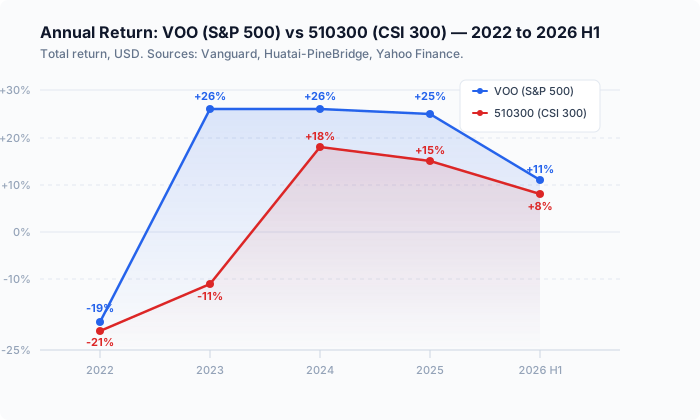
The CSI 300 had a banner 12 months — up ~31% — but long-term returns have lagged the S&P 500. A big reason: the index peaked in 2007 and again in 2015 before suffering deep drawdowns. China's equity market has been the world's most volatile major market, and buy-and-hold has been punishing at times.
Important context: The CSI 300's dividend yield has risen to ~2.7% — historically high relative to its own history and the Chinese 10-year bond yield. The yield spread is in the 95th percentile, which has historically been a contrarian buy signal for Chinese equities.
The Bull Case for CSI 300 ETFs in 2026
1. Valuation discount. At 17.6x trailing earnings, the CSI 300 trades at a ~20% discount to the S&P 500. If China's earnings recovery continues, that gap could narrow.
2. Dividend renaissance. Chinese companies — particularly state-owned enterprises in financials and energy — are distributing record dividends. The CSI 300's ~2.7% yield is nearly double the S&P 500's ~1.3%.
3. Wall Street is bullish. Goldman Sachs (target: 5,300), UBS, Morgan Stanley, and JPMorgan have all upgraded Chinese equities in 2026. Foreign northbound flows via Stock Connect have turned positive after a long period of outflows.
4. AI supply chain exposure. The CSI 300 is uniquely exposed to AI hardware — optical modules, batteries, semiconductors — that benefit from global AI investment regardless of who wins the software layer. If the AI buildout continues, these companies see demand.
5. Policy tailwinds. The government's "New Quality Productive Forces" (新质生产力) initiative is directing capital toward advanced manufacturing, green energy, and technology self-sufficiency — exactly the sectors that are growing their weight in the CSI 300.
The Bear Case
1. "National team" distortion. Central Huijin's massive presence in onshore ETFs (83% of 510300 at peak) means ETF prices don't purely reflect market forces. When the government decides to cool the market — as it did in January 2026 — it can trigger massive outflows. You are investing alongside an actor with non-commercial objectives.
2. Geopolitical risk. U.S.-China tensions over Taiwan, technology export controls, and trade policy remain elevated. Sanctions on Chinese AI chip firms or optical module makers could directly impact top CSI 300 holdings.
3. Property sector overhang. China's real estate market remains in a multi-year correction, weighing on consumer confidence and financial sector balance sheets. While the worst may be over, a full recovery is not priced in — and may not arrive soon.
4. Regulatory unpredictability. China's regulatory environment shifted dramatically in 2021 (tech crackdown), 2022 (zero-COVID), and has since pivoted to pro-growth. The direction can change quickly.
5. Currency risk. For USD-based investors, RMB depreciation would erode returns. The PBOC has managed the yuan tightly, but capital outflow pressure remains a structural risk.
Who Should Invest?
| Investor Profile | Recommendation |
|---|---|
| U.S. investor seeking diversified emerging market exposure | Allocate 5-10% of equity portfolio via ASHR (0.65%) or CNYA (0.60%). Use as a satellite holding, not a core position. |
| Asia-based investor with Stock Connect access | Buy 510300 (0.20% all-in) directly. The lowest-cost CSI 300 exposure available. |
| Income-focused investor | The CSI 300's 2.7% yield (and specific dividend-focused CSI ETFs) offers compelling income vs. U.S. bonds. |
| Passive index investor | The CSI 300 is not a replacement for S&P 500 exposure — it's a diversification tool. The volatility is too high for a core position. |
| Trader / tactical investor | CHAU (Direxion 2x Bull CSI 300) provides leveraged exposure, but this is a high-risk instrument for short-term trading only. |
The Bottom Line
The CSI 300 is China's most important equity benchmark — but it behaves very differently from the S&P 500. Higher volatility, higher dividend yields, a more cyclical sector mix, and the unpredictable influence of state-backed investors make it a fundamentally different instrument.
For global investors, the CSI 300 deserves a place in a diversified portfolio — but as a satellite allocation, not a core holding. Start with 5-10% of your equity exposure, use the lowest-cost vehicle available to you (ASHR in the U.S., 510300 if you have onshore access), and accept that the ride will be bumpier than what U.S. index investors are accustomed to.
Next on ETF Bridge: We compare U.S. and China ETF fees head-to-head — why does ASHR charge 0.65% while VOO charges 0.03%? The answer involves fund structure, securities lending, and market access costs. Read the US vs China ETF Fee Comparison →
Sources & Further Reading
- China Securities Index Co. (CSI) — CSI 300 Index Methodology
- Xtrackers / DWS — ASHR fund page
- Huatai-PineBridge — 510300 fund page
- Bloomberg — "China National Team ETFs Log Record Outflows" (January 2026)
- China Securities Journal — CSI 300 ETF analysis (May 2026)
- Goldman Sachs, UBS, Morgan Stanley — China equity strategy notes (Q2 2026)
- Stock Analysis — 510300 key metrics
- ETF.com / Yahoo Finance — ASHR performance data
Continue reading: Dive deeper into China's equity ecosystem — compare the CSI 300 with CSI 500 vs CSI 1000 for mid/small-cap exposure, explore A-share sector ETFs for thematic plays, or see how the Hang Seng Index complements your China allocation.
Disclaimer: ETF Bridge is an educational resource. This article does not constitute investment advice. Past performance does not guarantee future results. Investing in Chinese equities involves unique risks including regulatory changes, currency fluctuations, geopolitical tensions, and liquidity constraints. All data is current as of late June 2026 and may change. Always consult a qualified financial advisor before making investment decisions. Investing involves risk, including the potential loss of principal.