By Gerberal | June 29, 2026 | 10 min read
If you invest in U.S. stocks, you have almost certainly faced this question: Which S&P 500 ETF should I buy?
Three funds dominate the landscape — Vanguard's VOO, iShares' IVV, and State Street's SPY. Together they command over $2.6 trillion in assets. They all track the same index. Their performance charts look nearly identical when overlaid. So does it even matter which one you pick?
The short answer: yes, but the choice depends on who you are as an investor. The differences — in expense ratios, fund structure, dividend mechanics, and liquidity — add up to real money over decades. And in June 2026, one of these funds just made history.
Let's break it down, data point by data point.
The Contenders at a Glance
| Metric | VOO (Vanguard) | IVV (iShares/BlackRock) | SPY (State Street) |
|---|---|---|---|
| Expense Ratio | 0.03% | 0.03% | 0.0945% |
| AUM | ~$1.0 trillion | ~$850 billion | ~$790 billion |
| Inception | Sep 2010 | May 2000 | Jan 1993 |
| Fund Structure | Open-End Fund | Open-End Fund | Unit Investment Trust (UIT) |
| Avg Daily Volume | ~$4 billion | ~$6 billion | ~$45 billion |
| Dividend Yield (TTM) | ~1.08% | ~1.10% | ~1.05% |
| TTM Total Return (as of late June 2026) | ~25.5% | ~25.3% | ~25.4% |
| YTD 2026 Return | ~11.2% | ~10.8% | ~11.0% |
| 5-Year Annualized Return | ~13.5% | ~13.3% | ~13.3% |
| 10-Year Annualized Return | ~14.2% | ~14.1% | ~14.0% |
Data sourced from fund provider websites, Morningstar Direct, and ETF.com as of June 2026.
At first glance, the numbers look almost indistinguishable. The performance differences across all time horizons are measured in tenths of a percentage point. So what actually separates these funds?
The 3x Fee Gap That Compounds
The single most actionable number in this comparison is the expense ratio:
- VOO & IVV: 0.03% — that's $3 per year for every $10,000 invested.
- SPY: 0.0945% — $9.45 per year for every $10,000 invested.
SPY is more than 3 times more expensive than its competitors. It doesn't sound like much. But S&P 500 investing is a decades-long game, and the math is unforgiving:
| Scenario | VOO / IVV (0.03%) | SPY (0.0945%) | Fee Drag Difference |
|---|---|---|---|
| $10,000 invested, 30 years, 7% annual return | Final value: ~$74,870 | Final value: ~$73,460 | $1,410 lost |
| $100,000 invested, 30 years, 7% return | ~$748,700 | ~$734,600 | $14,100 lost |
| $500,000 invested, 30 years, 7% return | ~$3,743,500 | ~$3,673,000 | $70,500 lost |
The fee gap alone can cost a long-term investor tens of thousands of dollars. That's real money left on the table for what is, in every other respect, an identical product.
Why does SPY still charge more? State Street has been slowly lowering SPY's fee (it was 0.0945% for years, down from 0.09% in earlier eras), but it faces a structural constraint: SPY's UIT structure makes it harder to slash fees the way Vanguard and BlackRock — operating open-end funds that can cross-subsidize with securities lending revenue — have been able to do. More on this below.
The Hidden Difference: Fund Structure & "Dividend Drag"
Here's a detail that most retail investors never hear about — but it matters.
| VOO & IVV (Open-End Fund) | SPY (Unit Investment Trust) | |
|---|---|---|
| Dividend Reinvestment | Immediate — dividends are reinvested as they arrive from underlying stocks | Delayed — cash sits in a non-interest-bearing account until distributed quarterly |
| Securities Lending | Yes — revenue offsets expenses | No — UIT structure prohibits it |
| In-Kind Creation/Redemption | Yes — tax-efficient | Yes — but less flexible than open-end funds |
This difference creates what professionals call "dividend drag." When Apple or Microsoft pays a dividend, VOO and IVV can reinvest that cash immediately into more S&P 500 exposure. SPY must hold it in a sterile cash account until the quarterly distribution date. In a rising market, that idle cash misses gains — a small but compounding headwind.
Over a decade, researchers estimate dividend drag costs SPY investors an additional 2-5 basis points per year in forgone returns — on top of the explicit expense ratio gap. Combined with the higher fee, SPY's true all-in cost disadvantage vs. VOO/IVV may be closer to 8-10 basis points annually.
Why SPY Still Exists (And Dominates Wall Street)
If SPY is more expensive and structurally inferior for buy-and-hold investors, why does it still manage ~$790 billion?
1. Liquidity. SPY's average daily trading volume of $45 billion dwarfs VOO ($4 billion) and IVV (~$6 billion). For institutional traders moving hundreds of millions of dollars, SPY is the only game in town.
2. Options ecosystem. SPY is the most actively traded options vehicle on the planet. Its options chain offers unparalleled liquidity, tight spreads, and daily expirations. If you sell covered calls, trade put spreads, or hedge a portfolio with index options, you are using SPY.
3. Legacy. SPY was the very first U.S.-listed ETF, launched in January 1993. Generations of traders, advisors, and institutions built their workflows around it. That inertia is hard to break.
Bottom line: SPY is a trading vehicle. VOO and IVV are investing vehicles. Use the right tool for the right job.
VOO: The $1 Trillion Milestone
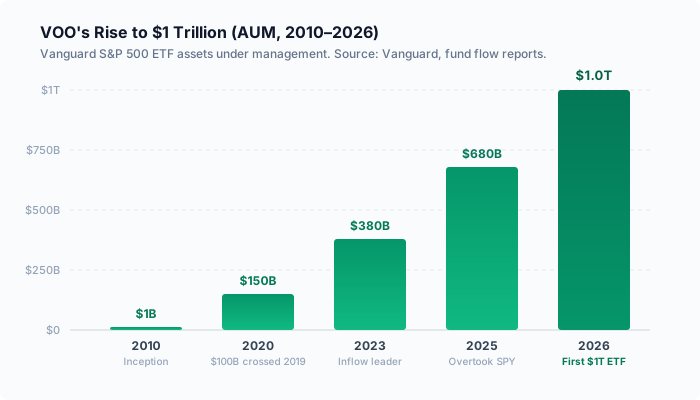
In early June 2026, VOO became the first ETF in history to surpass $1 trillion in assets under management — a landmark moment that underscores the dominance of passive investing.
I remember buying my first VOO shares in 2014, when the fund held less than $50 billion. At the time, the "smart money" consensus was that passive investing would hit a ceiling — that active managers would outperform once markets got more efficient. Twelve years later, VOO crossed $1 trillion while the average active large-cap fund is still trailing its benchmark. Sometimes the most boring investment is the most radical.
Some context on VOO's trajectory:
| Year | VOO AUM | Milestone |
|---|---|---|
| 2010 | ~$1 billion | Inception |
| 2020 | ~$150 billion | Crossed $100B in 2019 |
| 2023 | ~$380 billion | Surpassed SPY in daily inflows |
| 2025 (Feb) | ~$680 billion | Overtook SPY as world's largest ETF |
| 2026 (Jun) | ~$1.0 trillion | First trillion-dollar ETF |
VOO has pulled in over $69 billion in net inflows in 2026 alone — ranking #1 globally. The flywheel is self-reinforcing: more assets → more securities lending revenue → ability to keep the expense ratio at rock-bottom levels → more inflows.
IVV: The Quiet Giant
IVV doesn't get the headlines VOO does, but it shouldn't be overlooked:
- Older than VOO by a decade (launched May 2000 vs. September 2010)
- Same 0.03% expense ratio — tied for cheapest
- ~$850 billion in AUM — roughly the size of the Dutch economy
- Slightly higher dividend yield than VOO (~1.10% vs ~1.08%), though this difference is noise-level and can flip quarter-to-quarter
- BlackRock's securities lending program is widely regarded as industry-leading, generating revenue that partially or fully offsets the already-tiny expense ratio
For investors who prefer the iShares/BlackRock ecosystem — or whose brokerage offers commission-free IVV trading but charges for Vanguard ETFs — IVV is functionally identical to VOO. Performance over every meaningful time horizon differs by just 0.1%–0.2% annually.
Takeaway: The VOO vs. IVV choice is essentially a coin flip. Pick whichever your platform supports commission-free. Or if you can't decide — own both. The diversification you're getting is the S&P 500 itself, not the fund wrapper.
The Data Table That Matters
Here's the comparison in numbers, with the differences highlighted:
| VOO | IVV | SPY | Winner | |
|---|---|---|---|---|
| Annual cost per $10K | $3.00 | $3.00 | $9.45 | VOO / IVV |
| 30-year fee cost (on $100K) | ~$2,700 | ~$2,700 | ~$8,500 | VOO / IVV |
| Dividend reinvestment | Immediate | Immediate | Quarterly lag | VOO / IVV |
| Securities lending boost | Yes (~0.01–0.02%) | Yes (~0.02–0.03%) | No | IVV (marginal) |
| Options availability | Good | Good | Excellent | SPY |
| Bid-ask spread (avg) | 0.01% | 0.01% | 0.01% | Tie |
| Intraday liquidity | Very good | Very good | Unmatched | SPY |
| Fractional share support | Many brokers | Many brokers | Many brokers | Tie |
Who Should Buy Which ETF?
| Your Profile | Best Choice | Why |
|---|---|---|
| Long-term buy-and-hold investor | VOO or IVV | Lowest cost, open-end structure eliminates dividend drag, identical performance |
| Retirement account (IRA/401k) | VOO or IVV | Fee minimization matters most over decades |
| Dollar-cost averaging | VOO (or IVV) | Low cost + fractional share availability at most brokers |
| Active trader / swing trader | SPY | Unmatched intraday liquidity, tightest spreads for large orders |
| Options seller (covered calls) | SPY | Deepest options market on the planet |
| Institutional / large block | SPY | The only fund with the depth to absorb nine-figure trades without slippage |
| European / Asian investor (UCITS) | CSPX (iShares) or VUAA (Vanguard) | These are UCITS-compliant S&P 500 ETFs — VOO/IVV/SPY are U.S.-domiciled |
The 95% answer: If you're reading this as an individual investor building long-term wealth, buy VOO or IVV. Set up automatic investments. Stop comparing them. The real wealth-building happens not in choosing which S&P 500 ETF, but in staying invested through market cycles.
What About the S&P 500 Itself in Mid-2026?
The S&P 500 is up roughly 11% year-to-date as of late June 2026, building on its strong 2025 run. The index is being driven by a narrow set of mega-cap tech names — Nvidia (~7.9% of the index), Apple (~7.0%), and Microsoft (~5.1%) together account for roughly 20% of the S&P 500's weight.
This concentration risk is real and worth understanding — but it's a feature of the index, not of any particular ETF tracking it. VOO, IVV, and SPY all hold these same stocks at the same weights. (The Nasdaq-100 (QQQ) is even more concentrated — same names, higher weights.)
If you're concerned about concentration, we cover alternatives — equal-weight S&P 500 ETFs (RSP), international diversification, and China A-share ETFs like CSI 300 trackers — in other ETF Bridge guides.
The Verdict
| Rating | Notes | |
|---|---|---|
| VOO | ⭐⭐⭐⭐⭐ | Best all-around S&P 500 ETF for individual investors. Lowest cost, best structure, historic $1T milestone. |
| IVV | ⭐⭐⭐⭐⭐ | Functionally identical to VOO. Slightly edge in securities lending. Excellent choice. |
| SPY | ⭐⭐⭐⭐ | Unmatched liquidity, but structurally inferior for buy-and-hold. Worth the premium only if you trade or use options. |
For the vast majority of readers, VOO and IVV are the right answer. Pick one, automate your investments, and let compounding do the heavy lifting.
Next up on ETF Bridge: How does the CSI 300 ETF compare? We break down China's blue-chip index ETF options — expense ratios, tracking quality, and what global investors need to know. Read the CSI 300 ETF Guide →
Sources & Further Reading
- Vanguard VOO fund page — investor.vanguard.com
- iShares IVV fund page — ishares.com
- State Street SPY fund page — ssga.com
- ETF.com — VOO vs IVV vs SPY comparison tool
- Morningstar Direct — performance and AUM data
- InvestmentNews — "Vanguard's VOO becomes first ETF to surpass $1 trillion" (June 2026)
- NAI500 — "Vanguard's VOO Becomes World's First $1 Trillion ETF" (June 2026)
Continue reading: Build on your S&P 500 foundation — see how the Nasdaq-100 (QQQ vs QQQM) compares for tech-heavy growth, learn why equal-weight S&P 500 ETFs reduce concentration risk, or explore growth vs value to understand what drives returns beyond the broad market.
Disclaimer: ETF Bridge is an educational resource. This article does not constitute investment advice. Past performance does not guarantee future results. Expense ratios, AUM, and performance data are current as of late June 2026 and may change. Always verify information with the official fund provider and consult a qualified financial advisor before making investment decisions. Investing involves risk, including the potential loss of principal.