By Gerberal | June 29, 2026 | 10 min read
The cheapest S&P 500 ETF costs 0.03% per year. The cheapest CSI 300 ETF costs 0.20% per year. And if you're a U.S. investor buying a CSI 300 ETF through your brokerage? That's 0.65%.
Why does tracking 300 Chinese blue-chip stocks cost 20x more than tracking 500 American ones? The answer has nothing to do with index complexity — and almost everything to do with fund structure, market access costs, and who gets to decide what fees are fair.
This article takes a structural look at the forces driving ETF fees in the world's two largest equity markets. By the end, you'll understand not just what fees you're paying, but why — and whether that 0.65% fee is a fair price or a premium you can avoid.
The Fee Landscape at a Glance
| Category | Example ETF | Total Expense Ratio |
|---|---|---|
| US broad-market passive | VOO (Vanguard S&P 500) | 0.03% |
| US broad-market — legacy | SPY (SPDR S&P 500) | 0.0945% |
| US thematic / sector | SMH (VanEck Semiconductor) | 0.35% |
| China onshore broad-market | 510300 (Huatai-PineBridge CSI 300) | 0.20% |
| China onshore sector | Various CSI sector ETFs | 0.40%–0.80% |
| China QDII (cross-border outbound) | Nasdaq-100 QDII ETF | 0.80% |
| US-listed China A-share | ASHR (Xtrackers CSI 300) | 0.65% |
| US-listed China broad | MCHI (iShares MSCI China) | 0.59% |
| US-listed China ex-SOEs | CXSE (WisdomTree) | 0.32% |
Data as of mid-2026, sourced from fund provider websites and Caixin Global.
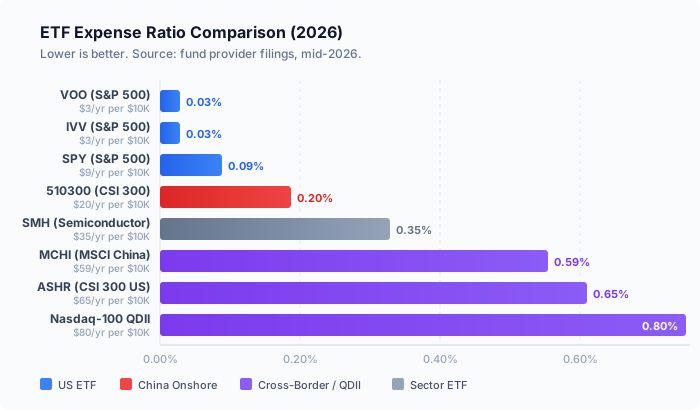
Three tiers immediately stand out:
- Tier 1 ($0.03–0.10%) — U.S. broad-market passive, driven by a decades-long fee race to the bottom
- Tier 2 (0.15–0.20%) — China onshore broad-market, the product of aggressive regulatory-driven fee cuts since 2023
- Tier 3 (0.60–0.80%) — anything involving cross-border access, where structural costs remain stubbornly high
Why US ETF Fees Went to Near-Zero
The 0.03% fee on VOO is not a pricing decision — it's the terminal point of a 40-year competitive war between the world's three largest asset managers.
The Race to Zero
| Year | Milestone |
|---|---|
| 1976 | Vanguard launches first retail index fund (0.46% ER) |
| 1993 | SPY launches at ~0.20% (first U.S. ETF) |
| 2000 | iShares IVV launches at 0.09% |
| 2010 | VOO launches at 0.06% |
| 2018 | Fidelity launches zero-fee index mutual funds |
| 2020 | VOO and IVV both cut to 0.03% |
| 2023–2026 | No further cuts — the floor has been found |
Why Can They Afford 0.03%?
Vanguard charges $3 per year for every $10,000 invested. On its $1 trillion in VOO assets, that's roughly $300 million in annual fee revenue. But that's not the full picture. Two mechanisms make sub-0.05% economics viable:
1. Economies of scale. VOO's $1 trillion AUM means fixed costs — index licensing, custody, audit, legal — are spread across an enormous asset base. The marginal cost of managing one more dollar is essentially zero. A CSI 300 ETF with $19 billion in AUM has a much smaller base to amortize costs.
2. Securities lending. Vanguard and BlackRock lend out the underlying stocks in their ETFs to short sellers, generating revenue that partially or fully offsets expenses. For VOO, securities lending income covers roughly 0.01–0.02% of costs annually — meaning Vanguard's actual take from the 0.03% fee is close to zero or slightly negative after lending offsets. The ETF itself becomes a loss leader for Vanguard's broader ecosystem (advisory services, mutual funds, 401(k) administration).
China's Fee Revolution: From 0.60% to 0.20% in Two Years
China's ETF fee story is radically different. It's not a multi-decade market competition — it's a two-year regulatory sprint.
The CSRC Fee Reform (2023–2026)
In July 2023, the China Securities Regulatory Commission (CSRC) launched a three-phase reform of the public fund industry's fee structure. The goals were explicit: reduce costs for investors, channel long-term capital into A-shares, and promote index investing as an alternative to stock-picking.
| Phase | Date | Action | Impact |
|---|---|---|---|
| Phase 1 | Jul 2023 | Cut active fund management fees | Active equity fund fees capped at 1.2% |
| Phase 2 | Dec 2023 | Cut custodian fees and trading commissions | Brokerage commissions reduced ~20% |
| Phase 3 | 2024–2025 | Aggressive passive ETF fee cuts | Broad-based ETF fees converge to 0.15% + 0.05% |
As of early 2026, over 370 of China's ~1,400 ETFs charge the new standard of 0.15% management + 0.05% custody = 0.20% total. That's a 67% reduction from the 0.60% standard that prevailed just three years ago.
The reform has saved Chinese investors an estimated ¥51 billion (~$7 billion) annually across the entire public fund industry. (Caixin Global, March 2026)
Why Not 0.03%?
Despite the rapid convergence, China's broad-based ETFs are unlikely to reach U.S.-level fees anytime soon for several structural reasons:
| Barrier | U.S. | China |
|---|---|---|
| Largest ETF AUM | $1 trillion (VOO) | ~$19 billion (510300) |
| Securities lending market | Deep, liquid, well-developed | Shallow — limited short-selling ecosystem |
| Index licensing costs | Negotiated at massive scale | Index remains CSRC-licensed; fees not fully market-driven |
| Custody architecture | Competitive custody market | State-backed custodian banks with limited fee flexibility |
| Competition model | Market-driven price war (40 years) | Regulatory-mandated cuts (2 years) |
Scale is the binding constraint. At $19 billion, the largest CSI 300 ETF is roughly 1/50th the size of VOO. Spreading fixed costs over 50x fewer assets means the break-even fee rate is structurally higher. As Chinese ETF assets grow — and they are growing, with 510300 alone taking in hundreds of billions in yuan during strong market periods — further fee compression is inevitable, but gradual.
The Cross-Border Premium: Why ASHR Costs 0.65%
This is where the fee story gets personal for global investors. If China's onshore CSI 300 ETF costs 0.20%, why does ASHR — the U.S.-listed version — charge 0.65%?
That 45 basis point gap is the cost of crossing borders.
The Cross-Border Cost Stack
| Cost Component | Onshore ETF (510300) | U.S.-Listed (ASHR) |
|---|---|---|
| Underlying ETF management | 0.20% | Included (ASHR holds the onshore ETF or swaps) |
| Cross-border custody | None | ~0.05–0.10% |
| FX conversion & hedging | None | ~0.05–0.10% |
| U.S. listing & compliance | None | ~0.05% (SEC filings, legal, audit) |
| Market access (RQFII/QFII quota) | None | ~0.05–0.10% |
| Manager profit margin | Near-zero | ~0.05–0.15% |
| Total | 0.20% | ~0.60–0.70% |
Every extra layer adds cost, and none of it is optional. When a U.S. ETF manager wants to deliver CSI 300 exposure to American investors, they must:
- Obtain RQFII/QFII quota — a regulatory allocation from Chinese authorities to invest onshore
- Contract a local sub-advisor — ASHR uses Harvest Fund Management, a top-tier Chinese manager
- Manage cross-border custody — the underlying A-shares sit in China's depository system (CSDC), requiring specialized custody arrangements
- Handle FX — dividends paid in RMB must be converted to USD for distribution
- File with the SEC — U.S.-listed ETFs face ongoing compliance costs
None of this is free. The 0.65% fee is not an arbitrary markup — it reflects genuine operational costs that don't exist for a purely onshore fund.
Is 0.65% Fair?
For context, ASHR's 0.65% is actually cheap for cross-border China exposure:
| Cross-Border China ETF | Expense Ratio |
|---|---|
| ASHR (CSI 300, U.S.) | 0.65% |
| CNYA (MSCI China A, U.S.) | 0.60% |
| FXI (FTSE China 50, U.S.) | 0.74% |
| QDII Nasdaq-100 ETF (China → U.S.) | 0.80% |
| QDII S&P 500 ETF (China → U.S.) | 0.65–0.80% |
Notably, the fee penalty is symmetric: Chinese investors pay just as much to access U.S. markets as U.S. investors pay to access Chinese markets. The cost is in the crossing, not the market you're crossing into.
The QDII Mirror: What It Costs to Invest From China
QDII (Qualified Domestic Institutional Investor) is the reverse channel — it lets Chinese fund managers invest overseas on behalf of mainland investors. The fees tell the same story:
| Channel | What It Does | Typical Fee |
|---|---|---|
| Domestic CSI 300 ETF | China → China | 0.20% |
| QDII CSI 300 ETF (if it existed) | China → China (redundant) | N/A |
| QDII Nasdaq-100 ETF | China → U.S. | 0.80% |
| U.S. QQ (Nasdaq-100, U.S.) | U.S. → U.S. | 0.20% |
Once again: crossing the border adds roughly 40–60 basis points, regardless of direction.
A useful mental model: Think of the cross-border ETF premium as a flat "international shipping cost" rather than a percentage fee. Whether you're shipping $10,000 or $10 million worth of index exposure across borders, the operational infrastructure costs roughly the same per dollar. This is why the fee premium shrinks as AUM grows — but never fully disappears.
Hidden Costs: Securities Lending and Tracking Difference
Expense ratios tell only part of the story. A subtler but equally important difference is what happens inside the portfolio.
Securities Lending Revenue
| ETF | Lending Revenue (est.) | Net Effect on Total Cost |
|---|---|---|
| VOO (0.03%) | ~0.01–0.02% offset | Effective cost: ~0.01–0.02% |
| IVV (0.03%) | ~0.02–0.03% offset | Effective cost: ~0.00–0.01% |
| 510300 (0.20%) | Negligible | Effective cost: ~0.20% |
| ASHR (0.65%) | Negligible | Effective cost: ~0.65% |
The U.S. securities lending market is the deepest in the world. Short sellers borrow shares to hedge, arbitrage, or speculate — and the ETF manager collects fees. In China, short selling is heavily restricted, and the securities lending market is nascent. Chinese ETFs simply cannot offset costs the way Vanguard and BlackRock do.
Tracking Difference
Tracking difference — the gap between what the index returns and what the ETF actually delivers — often matters more than the stated expense ratio:
| ETF | Index | Avg Annual Tracking Difference (5yr) |
|---|---|---|
| VOO | S&P 500 | -0.02% (nearly perfect) |
| 510300 | CSI 300 | -0.25 to -0.35% |
| ASHR | CSI 300 | -0.70 to -0.85% |
ASHR's tracking difference (~0.70–0.85%) is wider than its expense ratio (0.65%), meaning the actual total cost to investors — including trading costs, FX slippage, and dividend withholding — can approach 0.80–0.90% annually.
This is not unique to ASHR — it's the reality of operating a fund across jurisdictions with different trading hours, settlement cycles, and currency regimes.
What This Means for Your Portfolio
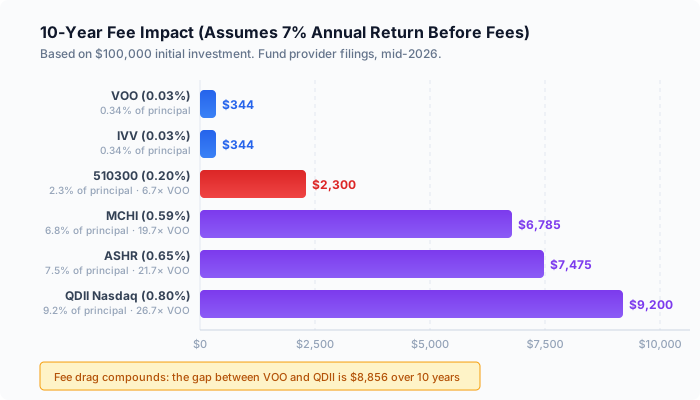
Scenario: $50,000 in an S&P 500 ETF vs. CSI 300 ETF (30 Years)
| VOO (US) | 510300 (China, onshore) | ASHR (China, US-listed) | |
|---|---|---|---|
| Stated expense ratio | 0.03% | 0.20% | 0.65% |
| Effective total cost | ~0.02% (after lending) | ~0.25% (incl. tracking) | ~0.80% (incl. tracking + FX) |
| 30-year cost drag on $50K, 7% return | ~$1,600 | ~$18,000 | ~$55,000 |
The structural gap is real: over 30 years, the higher costs of accessing China A-shares from the U.S. can consume over $50,000 in forgone returns on a $50,000 initial investment.
A Personal Note — I pay both sides of this fee structure with my own money. My US equity sleeve holds VOO and IVV at 0.03%. My China onshore holdings use 510300 at 0.20%. When I opened a US brokerage account and wanted CSI 300 exposure there, I faced the ASHR decision — 0.65% vs Stock Connect's onshore alternative. I chose Stock Connect. The account opening process was a bureaucratic headache (took 3 weeks, required notarized documents), but at 0.25% total cost vs 0.80% effective, the savings on a six-figure position pay for the paperwork many times over. If you don't have Stock Connect access, ASHR is a reasonable price for the exposure — I held it for 3 years before switching. Just know that the 60 bps premium compounds against you every year, and plan your access channel accordingly.
This doesn't mean you shouldn't invest in China. It means you should be deliberate about how you access it. If you have Stock Connect access, buy 510300. If you don't, ASHR's fee is a reasonable price for getting exposure you couldn't otherwise get — but you should know what you're paying.
Where Are Fees Headed?
China Onshore: More Cuts Coming
The CSRC's reform is not done. Industry analysts expect further compression in passive ETF fees over 2026–2027, with the 0.20% standard potentially falling to 0.15% or even 0.12% for the largest broad-based products. But the 0.03% U.S. floor is unlikely to be reached without:
- At least one Chinese ETF crossing $100 billion in AUM
- A deeper securities lending market
- Market-driven competition replacing regulatory mandates
Cross-Border: The Premium Will Persist
The 40–60 basis point cross-border premium is structural, not cyclical. Unless China fully liberalizes its capital account (a multi-decade prospect), the operational costs of moving money and securities across borders will remain. The best hope for fee reduction is scale — as ASHR grows beyond $5–10 billion in AUM, its fees could drift toward 0.40–0.50%.
Key Takeaways
-
The U.S. fee floor (0.03%) is an anomaly, not a baseline. It's the product of 40 years of market-driven competition, trillion-dollar scale, and deep securities lending markets. No other market in the world matches it.
-
China's ETF fees have fallen dramatically — from 0.60% to 0.20% in two years — but the decline is regulatory-driven, and the bottom is determined by scale, not competition.
-
Cross-border access costs 40–60 basis points of structural premium, regardless of direction. ASHR at 0.65% is not expensive for what it does — but it's a permanent cost drag versus direct onshore access.
-
Securities lending widens the real gap — the effective cost difference between VOO and 510300 is closer to 20–25 basis points than the stated 17 basis points, because U.S. ETFs offset fees with lending revenue.
-
For global investors, the choice is simple: if you have Stock Connect or onshore access, buy the cheapest local ETF. If you don't, a U.S.-listed China ETF is worth the fee — just be aware of what you're paying.
Next on ETF Bridge: We compare Nasdaq-100 ETFs — QQQ, QQQM, and the alternatives — and explain why Invesco charges 0.20% for an index that you can now track for 0.05%. Read the Nasdaq-100 ETF Face-Off →
Continue reading: Fees are only one piece of the puzzle — learn how tracking error reveals the true cost of an ETF, see how ETFs compare to mutual funds on fees and tax efficiency, and understand when to use ADRs vs local stocks vs ETFs for cross-border investing.
Sources & Further Reading
- Caixin Global — "Lower Fees, Bigger Gains: How China's ETF Fee Reform Is Putting Money Back in Investors' Pockets" (March 2026)
- Securities Daily — "Fee Reform Reshapes Public Fund Industry" (June 2026)
- China Securities Regulatory Commission — Three-phase fee reform documents (2023–2025)
- Morningstar China — "3.61 Trillion Behind the Fee War" (July 2025)
- Vanguard, BlackRock (iShares), State Street — fund pages for VOO, IVV, SPY
- Huatai-PineBridge — 510300 fund page
- DWS / Xtrackers — ASHR fund page
- Jiemian — QDII vs. Stock Connect tax/fee comparison (May 2026)
Disclaimer: ETF Bridge is an educational resource. This article does not constitute investment advice. Past performance does not guarantee future results. Expense ratios, tracking differences, and market conditions are current as of late June 2026 and may change. The analysis of fee structures is provided for educational purposes. Always verify fees with the official fund provider and consult a qualified financial advisor before making investment decisions. Investing involves risk, including the potential loss of principal. Cross-border investing carries additional risks including currency fluctuations and regulatory changes.